Charels Nessler
The Birth of the Permanent Wave – From Early Experiments to the Industrial Era
Permanent Wave History (1902–1950) the permanent wave changed the history of hairdressing.
Before the early twentieth century, curls could be created temporarily — but they rarely lasted. Humidity, washing and time quickly removed the effect. Hair could be styled, but not permanently reshaped.
This changed through the work historically associated with Charles Nessler (Karl Ludwig Nessler), the inventor linked to the first commercially successful permanent wave machine and the early development of modern permanent waving technology.
Between 1902 and 1950, the permanent wave evolved from experimental apparatus into an international beauty industry supported by patents, electrical systems, salon networks and industrial production.
This page explores the technological history of the permanent wave, its early development, patent expansion and commercial growth in London and New York.
Before the Permanent Wave (1902–1908)
The earliest documented patent activity connected to this development dates to 1902.
These first filings were not yet focused on curling natural hair itself. Instead, they explored structural manipulation techniques associated with artificial hairpieces, eyelashes and related materials.
This early phase reveals an important historical point:
The permanent wave did not originally emerge from fashion alone. It developed through technical experimentation and an increasing understanding of hair as a controllable material.
By the late 1900s, attention shifted from artificial additions toward the reshaping of natural hair itself. The question was no longer whether hair could be altered — but how to alter it systematically and permanently.
1909: The First Permanent Wave Machine and Technical Breakthrough
Patent priority filings from 1909 mark a decisive turning point in the history of the permanent wave.
For the first time, permanent waving was described as a repeatable technical process supported by apparatus, controlled heat and mechanical structure.
Heat, tension and electrical assistance were integrated into a coordinated system designed to reshape hair for longer periods of time.
This was no longer simple hairstyling. It was applied engineering.
Subsequent filings in Switzerland, the United Kingdom and the United States refined the method, improved stability and expanded legal protection across international markets.
Charles Nessler is widely associated with the invention of the permanent wave and the first commercially successful permanent wave machine.
From Experiment to Business (1912)
By 1912, the development of permanent waving had moved beyond experimental work.
Incorporation records in London document the formation of Nestle and Company Ltd., reflecting the transition from individual experimentation toward structured commercial enterprise.
What began as technical trial and error developed into a business built around mechanical refinement, patent protection and specialised equipment.
The permanent wave was no longer merely an invention.
It had become an emerging industry.
Permanent Wave Expansion from London to New York
During the 1920s, the focus increasingly shifted toward the American market.
Advertisements from New York document the activities of the Nestle Lanolin Co., Ltd., promoting a “Home Outfit for Permanent Waving” based on the Lanoil Process. The address — 12–14 East 49th Street, Manhattan — positioned the company within the commercial centre of New York.
This phase helped introduce permanent waving to a wider consumer audience through structured distribution and direct-response advertising.
By 1927, advertising under the name C. Nestle Co. promoted the “Circuline Method” and introduced the Nestle Text-O-Meter — a diagnostic instrument intended to analyse hair structure before treatment.
The method reflected a growing emphasis on classification, measurement and reduced heat exposure rather than uncontrolled application.
In 1929, references to The Nestle-Mira Company demonstrate continued technical positioning, with emphasis placed on controlled results, salon procedures and specialised apparatus.
By 1935, advertising for The Nestle-Lemur Company highlighted licensed beauty shops, certified materials and hygienic standards, indicating the existence of a structured salon network rather than isolated experimentation.
Across changing company names and business structures, references to the original invention and the New York operations remained consistent.
Technology During Industrial Change
The 1910s and 1920s were shaped by political instability, economic disruption and global conflict.
Despite these conditions, patent activity and technical development continued across Europe and the United States.
The permanent wave did not remain a single static invention. Instead, it evolved through continuous refinement involving heat regulation, electrical systems, apparatus safety and application control.
Protection filings across multiple countries suggest ongoing adaptation within a rapidly industrialising world.
Industrial Development of the Permanent Wave Industry (1926–1950)
By the interwar and post-war decades, permanent waving technology had become increasingly systematised. Patent records from this period reveal a shift toward electrically heated systems, integrated safety mechanisms and standardised apparatus components designed for repeated salon use.
What once required manual adjustment and experimental handling became electrically powered, engineered and commercially scalable.
The permanent wave had transformed from a technical curiosity into a structured industrial technology connected to the global beauty industry.
More Than a Hairstyle
Between 1902 and the middle of the twentieth century, permanent waving passed through several major stages:
-
Early structural experimentation
-
Controlled apparatus development
-
International patent expansion
-
Commercial growth in London and New York
-
Industrial and electrical scaling
-
Structured salon systems and professional distribution
The history of the permanent wave is therefore more than a story of fashion.
It is also a history of technological adaptation, industrial organisation and commercial expansion.
What began as experimental work on hair structure developed into one of the most influential technologies in modern hairdressing history.

The Circuline Method – Precision and Individualisation (1927)
The advertisement shown above was published in The Ladies’ Home Journal in April 1927. It promotes the “Nestle Circuline Wave” and names:
C. Nestle Co.
12 East 49th Street, New York City.
By 1927, the marketing emphasis had clearly shifted toward scientific individualisation. The Circuline Method is presented as a system that adapts the permanent wave to different hair types, comparable to how an oculist prescribes lenses.
A central element of the campaign is the Nestle Text-O-Meter, a diagnostic instrument designed to analyse hair structure before treatment. The advertisement stresses:
-
Classification of hair into distinct types
-
Individualised treatment formulas
-
Reduced heat exposure
-
Elimination of guesswork
-
Controlled, predictable results
The text explicitly refers to Mr. Charles Nessler as the original inventor of permanent waving, reinforcing the historical continuity of the brand in the American market.
This 1927 source demonstrates that the Nestle enterprise in New York was already promoting a structured, research-based method well before the 1930s expansion into broader licensing and award-based positioning.
Rather than focusing on home use, the Circuline campaign presents permanent waving as a professional, measured, and carefully prescribed salon procedure.
In the 1920s, the permanent wave entered a new phase.
It was no longer limited to specialised salons. It was marketed directly to American households.
The advertisement above appeared in Photoplay Magazine, one of the most influential film publications of its time. It promotes the “Nestle Home Outfit for Permanent Waving” using the so-called Lanoil Process. The address given — 12–14 East 49th Street, New York — places the company in the commercial heart of Manhattan.
The business operated under the name
Nestle Lanolin Co., Ltd.
and was associated with the American activities of
Karl Ludwig Nessler, known in the United States as Charles Nestle.
What makes this advertisement historically significant is its strategy. It presents the permanent wave as:
-
A modern beauty solution
-
A long-lasting transformation
-
Affordable when calculated “per day”
-
Accessible through a home kit
-
Supported by testimonials and film personalities
This marks the transition from technical invention to industrial distribution.
The permanent wave was no longer just a salon innovation — it had become a consumer product.
The name “Nestle” in this context refers to a haircare enterprise active in New York during the early 20th century and should be understood within the historical framework of Nessler’s American expansion.
Further archival research is ongoing to clarify the corporate structure and timeline of this company.

%2C%2023%20May%201929_%20Chronicling%20America_%20Historic%20American%20Newsp.png)
The Nestle Text-O-Meter – Standardising the Permanent Wave (1929)
The advertisement shown above was published in the Evening Star (Washington, D.C.) on 23 May 1929. It introduces the Nestle Text-O-Meter, a diagnostic instrument designed to test the condition of the hair before permanent waving.
The company name given in the advertisement is:
The Nestle-Mira Company – New York City.
By 1929, the marketing emphasis had clearly shifted toward technical precision and scientific control. Rather than promoting a home kit or salon certification system, this campaign highlights measurement, individualisation, and safety.
Key elements of the advertisement include:
-
The “Text-O-Meter” as a preparatory testing device
-
Individual assessment of hair condition
-
Reduced risk of hair damage
-
The phrase “Originators of Permanent Waving”
-
A direct association with Charles Nestle, the American name used by
Karl Ludwig Nessler
The message is clear: permanent waving is no longer experimental. It is presented as a controlled, measurable, and professional procedure supported by specialised equipment.
This 1929 source demonstrates that the Nestle enterprise in New York was actively developing not only chemical processes, but also mechanical and diagnostic systems aimed at standardising results across salons.
Further archival research is required to clarify whether “The Nestle-Mira Company” represented a formal reorganisation, a subsidiary entity, or a branding variation within the broader Nestle permanent wave business in the United States.
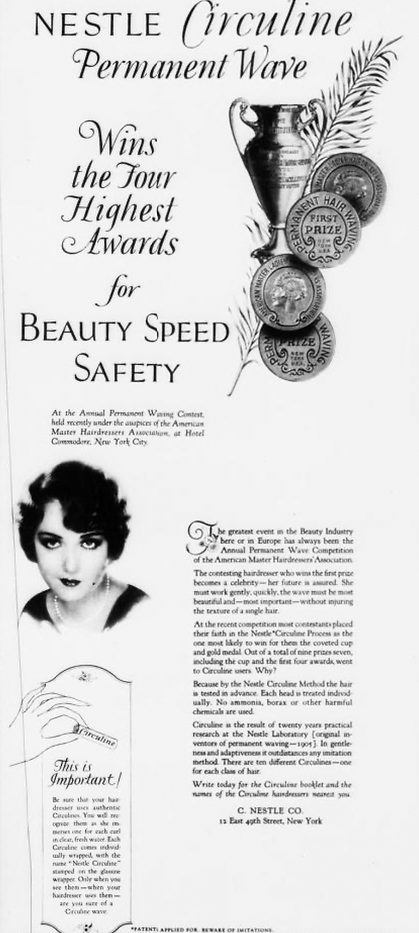
The Circuline Method and C. Nestle Co.
The advertisement above introduces yet another corporate designation:
C. Nestle Co.
13 East 49th Street, New York.
By this stage, the branding had evolved toward the “Nestle Circuline Permanent Wave.”
The campaign emphasises:
-
Industry awards
-
Safety and speed
-
Scientific credibility
-
Official competitions
-
Authentic Nestle materials
The reference to “original inventors of permanent waving – 1905” directly links the company’s American identity to the pioneering work of
Karl Ludwig Nessler.
The shift from home kits to licensed salons and finally to competition-winning systems suggests a structured and adaptive business strategy within the American beauty industry.
Further archival research is required to determine whether these corporate names represent formal reorganisations, parallel entities, or branding evolutions within the same business group.

By June 1935, the branding had evolved.
The advertisement shown above appeared in Photoplay Magazine and prominently names:
The Nestle-Lemur Company – New York
This marks a transition from the earlier “Nestle Lanolin Co., Ltd.” to a new corporate identity.
The focus of the campaign is no longer the home kit. Instead, it emphasises:
-
Licensed Nestle Beauty Shops
-
Official certification
-
Hygienic safety standards
-
Protection against “re-used pad practice”
-
Authentic Nestle materials
The language reflects a more regulated, professionalised salon system.
The headline “Scientific Permanent Wave” reinforces the positioning of the brand as the originator of the modern permanent wave — a claim historically linked to
Karl Ludwig Nessler.
This 1935 advertisement demonstrates that the Nestle haircare enterprise remained active in New York at least into the mid-1930s and operated under the name “Nestle-Lemur Company.”
Further archival documentation is required to determine:
-
The exact date of the corporate name change
-
The ownership structure of the Nestle-Lemur Company
-
The relationship between the earlier Lanolin company and this later entity
